In the beginning
The Ndwandwe Nation at Egudu
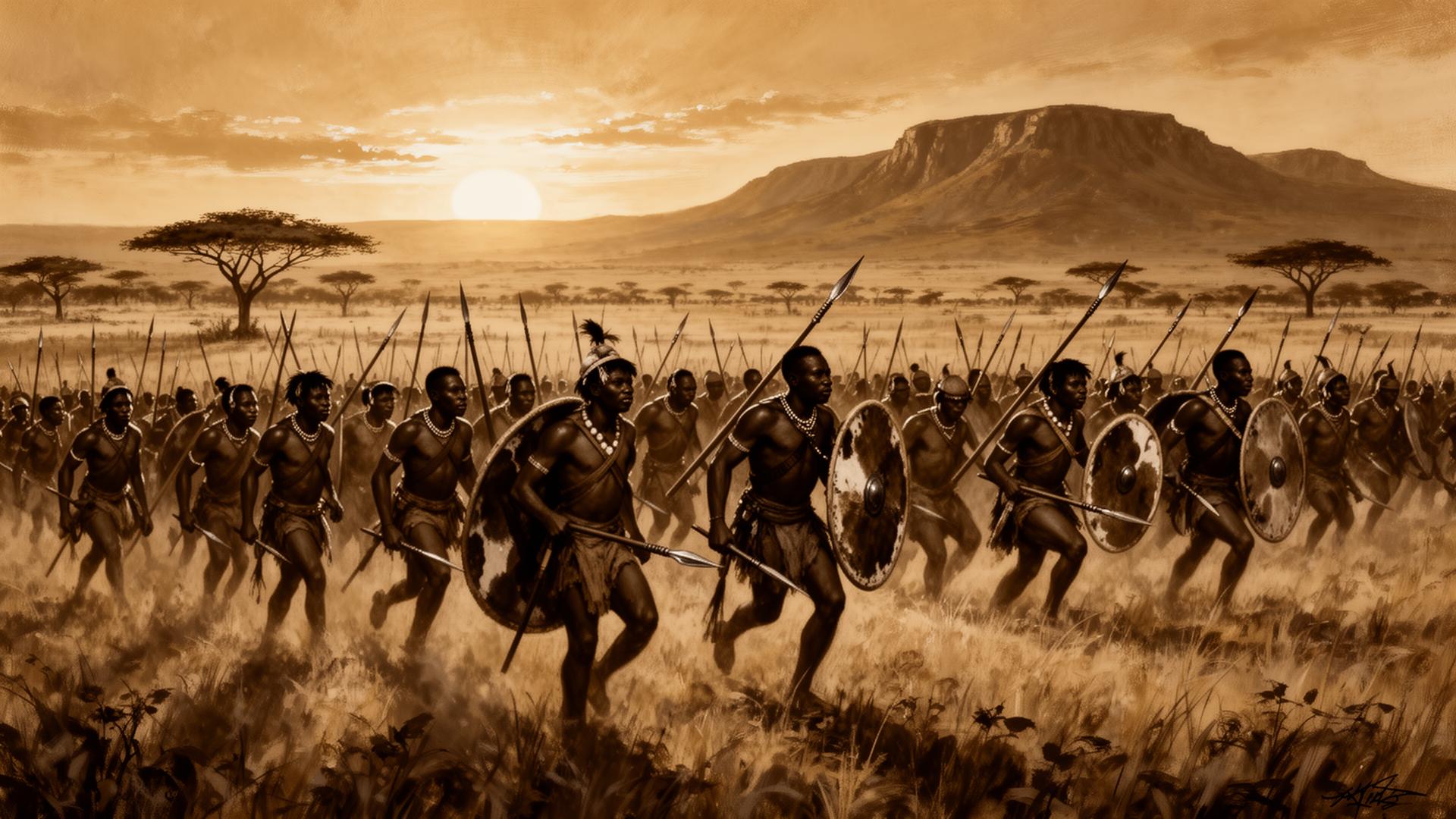
Long before the rivers of our people were turned by war, King Zwide kaLanga ruled the powerful Ndwandwe nation from his capital at Egudu, in what is today known as Zululand in KwaZulu-Natal, South Africa. The Ndwandwe were one of the three great Nguni powers of the late 18th and early 19th centuries — feared, wealthy in cattle, organised in regiments, and ruled by a king whose name carried weight from the Phongolo to the sea.
Zwide was the son of Langa kaXaba. He built an empire that absorbed and allied with many smaller chiefdoms, and for a moment in history, the Ndwandwe were the dominant force of the southeast African coast.
The Mfecane
The Wars That Scattered Nations
The world changed when a young general named Shaka kaSenzangakhona rose among the Zulu. The clash between Zwide and Shaka — at the battles of Gqokli Hill and later at the Mhlatuze River — broke the Ndwandwe army. Zwide was defeated. His people fragmented. Some fled north under Soshangane to become the Gaza empire in Mozambique. Others scattered toward the highveld. Others moved into Swati country.
This great scattering is what history remembers as the Mfecane — "the crushing." For our family, it was the beginning of a journey.
The journey north
Prince Madzanga 1 Visits His Sister
Among the many sons of Zwide was Prince Madzanga 1. As the Ndwandwe moved northward in the aftermath of defeat, Madzanga chose to visit his blood sister, Thandzile (Laz'dze). Thandzile had been requested by the Swati king as a royal bride — a deliberate act of diplomacy in an age when marriage between great houses was the only language stronger than the assegai. By taking a daughter of Zwide, the Swati king sought to avoid war with the powerful Ndwandwe.
When Madzanga arrived in the land of his sister, he did not return south. Eswatini became home.
The Magagula
Settling with Chief Moyeni Magagula
Madzanga settled with the Magagula clan, under the leadership of Chief Moyeni Magagula — a wealthy and respected leader whose people had been on the land as basotho, long before the Swati kings established their kingdom. The Magagula offered hospitality. The Ndwandwe prince offered counsel, cattle, and the loyalty of a man who had nothing to return to.
Mswati II
When Madzanga Saved the Magagula
History records a moment when the wrath of King Mswati II turned against the Magagula. The Swati king's regiments were ready to descend, and the Magagula faced ruin. It is told that Prince Madzanga 1, by the weight of his own royal blood and the diplomacy of his sister Queen Thandzile, intervened — speaking for the Magagula and turning aside the king's anger. The Magagula were spared. The bond between the two houses was sealed in gratitude, and the Ndwandwe in Eswatini found in the Magagula a permanent home.
The two sons
Ndlaludlaza 1 and Yomncayi
Prince Madzanga 1 had many sons, but two stand prominent in our remembrance: Ndlaludlaza 1, the elder, and Yomncayi, the younger. From Ndlaludlaza 1 came the senior line that today sits at the Indlunkhulu — the great house at Umphakatsi Etfuntini. From Yomncayi came the line of BaYomncayi — our line — and from his sons came the six Tindlu: Engiyandi, Edulo, Emvangazini, Embuzini, Esiceywini, and Emakholweni.
Today
The Royal Seat at Etfuntini
The chieftaincy of the Ndwandwe in Eswatini today rests with the senior descendants — the Indlunkhulu — at Umphakatsi Etfuntini, under Honourable Chief Ndlaludlaza Ndwandwe, who also serves the Kingdom as Minister of Public Works and Transport. Within our own BaYomncayi line, the chieftaincy once passed to Nqcobeya Ndwandwe, a son of Yomncayi, when his older brother Zwide III died leaving behind a young son who would in time grow up to become Madzanga II — the father of today's Chief Ndlaludlaza.
We remember. We honour. We continue.
Nxumalo! Ndwandwe! Zwide kaLanga! wenawasegudu Wenawasegudunkhomo
BeNguni — United as One.